Best Sellers
 Olivia Cabinet Bed
 Massage Chairs
 Saunas
 Living Room
 Bedroom
 Dining Room
 More
More


Quick answer
An infrared sauna warms your body directly with heat panels, so the air stays cooler (up to 150°F in ours) and it plugs into a regular outlet. A traditional sauna heats the air with a stove and rocks, runs hotter, makes steam and needs a 240V line. See both types in our home saunas.
Last updated October 2026 by the Forward Furniture team
Shop saunas
-
Haven Heat Infrared Sauna
$1,899 – $3,69990-day home trialFree pickup in KelownaCalgaryEdmonton · from $158/mo
Aurora Panorama Barrel Sauna — 6 to 8 Person Outdoor Sauna
$9,999$7,499.9990-day home trialFree pickup in KelownaCalgaryEdmonton · $624/mo
Nordic Porch Barrel Sauna — 4 to 6 Person Outdoor Sauna
$6,133$4,999.9990-day home trialFree pickup in KelownaCalgaryEdmonton · $416/mo
Both types make you sweat. The real differences are how the heat reaches you, how hot it gets, what power it needs and where it can go.
We sell both kinds, so this guide uses real numbers from real models. The Haven Heat Infrared Sauna starts at $1,899.99. Our traditional barrel saunas, the Nordic Porch at $4,999.99 and the Aurora Panorama at $7,499.99, use a 6 kW stove with rocks. You can compare all of them in our sauna collection.
In this guide
- What is the difference?
- Which one gets hotter?
- What does each one feel like?
- What power does each need?
- How much space does each need?
- Which one costs more?
- Is infrared better for your health?
- Pros and cons
- Side by side table
- How we compared
- Which one is right for you?
- Questions
What Is the Difference Between an Infrared and a Traditional Sauna?
The difference is what gets heated. A traditional sauna heats the air, and the hot air heats you. An infrared sauna heats you, and the air warms up as a side effect. Everything else follows from that.
How each type heats you (simplified, not to scale). - Traditional: an electric stove warms a pile of rocks and the air around it. Hot air rises, fills the room and wraps around your body. Pour water on the rocks and you get a burst of steam.
- Infrared: heat panels on the walls and floor give off infrared heat, the same kind you feel from the sun on your face. It warms your skin and body first. There are no rocks and no steam.
Our Haven Heat uses ceramic heater panels on the walls with a carbon heater in the floor. The 1 Person has 5 ceramic heaters, and each size up adds one more, per the maker's spec on the product page. Our barrels use one 6 kW electric stove with a tray of rocks.

Which Sauna Gets Hotter?
A traditional sauna gets hotter. The owner's manual for a 6 kW Harvia sauna heater puts a suitable room temperature at about 149 to 176°F (65 to 80°C). Our Haven Heat infrared sauna reaches up to 150°F, and its product page puts the normal range at 110 to 150°F.
Why do infrared saunas not get as hot? They do not need to. The panels warm your body directly, so you sweat at a lower air temperature. Pushing the air to 180°F is the job of a stove, not a heat panel.
Heat up time follows the same logic:
- Haven Heat: about 15 minutes to reach 110 to 150°F, per our product page.
- Traditional: the owner's manual for a 6 kW Harvia sauna heater says a properly sized heater takes about an hour to bring a well insulated room to bathing temperature. A barrel outside in January can take longer.
What Does Each Sauna Feel Like?
A traditional sauna is intense. The air is hot enough that your face and shoulders feel it first, and a ladle of water on the rocks sends a wave of moist heat around the room, called löyly in Finnish.
Infrared feels gentler. The air is cooler and dry, so breathing is easier, and the warmth builds from the panels behind and beside you. Many people sit longer in it for that reason. Our product page suggests 3 to 5 sessions a week of 15 to 30 minutes each.
What about the 200 rule? It is a traditional sauna guide: temperature in °F plus humidity in percent should add up to about 200. It does not apply to infrared, which runs dry. Our guide on how to choose a home sauna explains it with an example.

What Power Does Each Sauna Need?
Power is where most buyers find their answer. A typical Canadian household circuit is 15 amps at about 120 volts, which tops out near 1,800 watts.
- Haven Heat 1 and 2 Person: plug into a standard 110V household outlet. No electrician needed. Keep other heavy loads off that circuit.
- Haven Heat 3 Person: best on a dedicated 20 amp circuit, per our product page.
- Traditional with a 6 kW stove: 6,000 watts at 240 volts is 25 amps, which matches the 25.0 amp rating in the owner's manual for a 6 kW Harvia sauna heater. At 120 volts it would need 50 amps, which no outlet gives you. Plan on a licensed electrician running a 240V line and hardwiring the stove.
Running cost is kilowatts times hours times your power rate. Take an example rate of 12 cents per kWh:
- A plug in sauna on a 15 amp circuit can never pass about 1.8 kW. One hour at that limit is about 22 cents.
- A 6 kW stove at full power uses 6 kWh in an hour, about 72 cents.
- Both use less once they reach temperature, but a traditional sauna also runs through its warm up.
For the same math on another appliance, see how much electricity a massage chair uses.
How Much Space Does Each Sauna Need?
Infrared cabins are built for indoors. Ours stand 75 inches tall, so they fit under a normal ceiling in a spare room, a basement or a home gym. Traditional saunas with a wood stove or rocks can go indoors too, but they need room for the heater, venting and a 240V line, so most home buyers put them outside.
- Haven Heat 1 Person: 35 by 35 inches, about 8.5 square feet of floor.
- Haven Heat 2 Person: 47 by 41 inches, about 13.4 square feet of floor.
- Haven Heat 3 Person: 60 by 47 inches, about 19.6 square feet of floor.
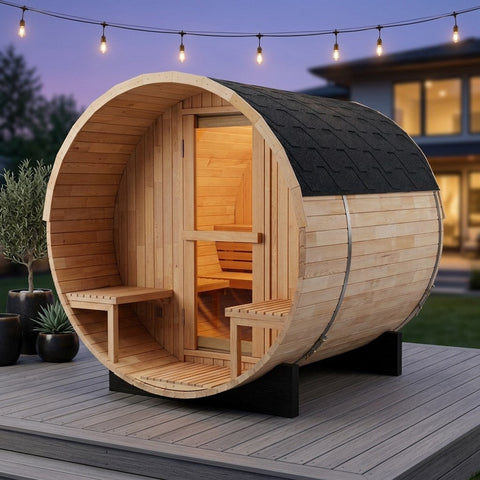
- Nordic Porch: 71 inches round and 71 inches long, about 35.0 square feet, plus room for the door to swing and a level base.
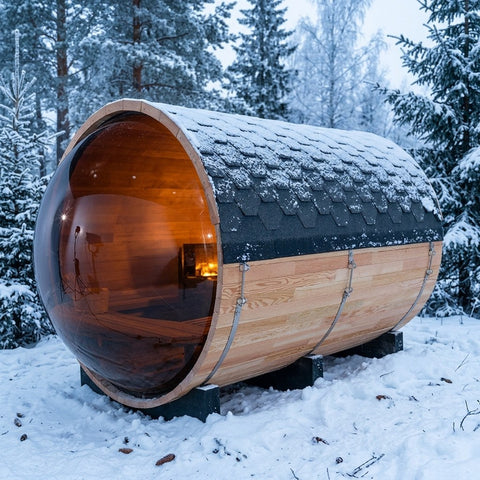
- Aurora Panorama: 71 inches round and 94.5 inches long, about 46.6 square feet, plus room for the door to swing and a level base.
Going outside in a Canadian winter? Our guide on how a barrel sauna works covers bases, snow, door habits and heat loss in the cold.

Are Infrared or Traditional Saunas More Expensive?
In our range, traditional costs more. Our Haven Heat infrared saunas run from $1,899.99 for 1 person to $3,699.99 for 3. Our barrels run from $4,999.99 for the Nordic Porch to $7,499.99 for the Aurora Panorama, and they seat more people.
The sticker price is not the whole bill. Add these before you compare:
- Wiring: a 240V line and hardwiring for a 6 kW stove. Get a quote from a licensed electrician, since the run length changes the price.
- A base: a level, well drained pad for an outdoor barrel.
- Permits: new wiring may need one where you live.
- Delivery: our barrel saunas ship for $49 to $249 depending on your order total. The Haven Heat has its own delivery rate, shown on its product page and at checkout.
Per seat, the gap closes. A barrel that seats 4 to 6 costs less per person than a 1 person cabin. If the whole family will use it, do that math too.
Is an Infrared Sauna Better for Your Health?
Nobody can honestly say one is better. The best known long study looked at traditional Finnish saunas. It followed 2,315 middle aged men for about 20 years, and men who used a sauna 4 to 7 times a week had lower rates of fatal heart disease than men who went once a week (JAMA Internal Medicine, 2015). It showed a link, not proof, and it did not test infrared.
The wider research is thin. a 2018 systematic review found 40 studies of regular dry sauna use with 3,855 people. Only 13 were randomized trials, and most were small. The authors called the benefits potential and asked for better data.
So pick the sauna you will use most. Frequency is the one thing the research keeps pointing to. Ask your doctor first if you are pregnant, have a heart or blood pressure condition, or take medicine that affects heat. Drink water, and leave at once if you feel dizzy.
Benefits and Disadvantages of Each Type
Infrared
- Plugs into a regular outlet (our 1 and 2 Person).
- Heats in about 15 minutes.
- Fits indoors in a small footprint.
- Gentler, drier heat.
- Disadvantages: no steam, a lower top temperature, and fewer seats.
Traditional
- Real high heat and steam from water on the rocks.
- Room for a group: our barrels seat 4 to 8.
- The type the long Finnish study looked at.
- Disadvantages: a 240V line, a longer warm up, outdoor space and a higher price.

Infrared vs Traditional: Our Saunas Side by Side
Model Type Seats Heat source Heat Warm up Power Size Price Haven Heat 1 Person Infrared, indoor 1 5 ceramic panels + carbon floor heater Up to 150°F About 15 min 110V outlet 35 x 35 in $1,899.99 Haven Heat 2 Person Infrared, indoor 2 6 ceramic panels + carbon floor heater Up to 150°F About 15 min 110V outlet 47 x 41 in $2,699.99 Haven Heat 3 Person Infrared, indoor 3 7 ceramic panels + carbon floor heater Up to 150°F About 15 min Dedicated 20A circuit 60 x 47 in $3,699.99 Nordic Porch Traditional, outdoor 4 to 6 6 kW stove with rocks About 149 to 176°F typical About 1 hour or more 240V hardwired, 25A 71 in round x 71 in long $4,999.99 Aurora Panorama Traditional, outdoor 6 to 8 6 kW stove with rocks About 149 to 176°F typical About 1 hour or more 240V hardwired, 25A 71 in round x 94.5 in long $7,499.99 Haven Heat heat, warm up, power and sizes from its product page and the maker's spec image; barrel sizes and heater from the maker's data on each product page; barrel heat and warm up from the Harvia 6 kW heater manual (a typical range, not a test of our units). Prices from our catalogue, read October 14, 2026.
How We Compared
- What we looked at: heat source, top temperature, warm up time, power, floor space, seats and price.
- Where the facts came from: our own product pages and catalogue for our saunas, the Harvia manual for how a 6 kW traditional heater behaves, and published research for health.
- What we did not do: time warm ups or measure temperatures ourselves.
- Prices checked: October 14, 2026. Prices change, so the product pages always show the current one.
The Saunas We Carry
Prices are read from our catalogue on the day this guide was updated.

Haven Heat Infrared Sauna, 1 Person
1 Person $1,899.99Infrared, indoor. 35 x 35 in. Plugs into a 110V outlet.
Haven Heat Infrared Sauna, 2 Person
2 Person $2,699.99Infrared, indoor for two. Plugs into a 110V outlet.
Haven Heat Infrared Sauna, 3 Person
3 Person $3,699.99Infrared, indoor. Best on a dedicated 20A circuit.
Which Sauna Is Right for You?
- You live in a condo or have no yard: infrared. The Haven Heat 1 Person at $1,899.99 fits in about 8.5 square feet and plugs in.
- You want a quick daily session for two: the Haven Heat 2 Person at $2,699.99 warms up in about 15 minutes.
- You love steam and high heat: traditional. The Nordic Porch at $4,999.99 seats 4 to 6.
- You host friends or have a view: the Aurora Panorama at $7,499.99 seats 6 to 8 behind a glass end wall.
- You cannot run a 240V line: infrared is your only plug in choice.

Building a recovery corner? Browse our wellness and recovery picks.
Infrared vs Traditional Sauna Questions
Is an infrared sauna much better than a regular sauna?
Not better, just different. Infrared is cooler, dry, quick to heat and plugs in. A regular sauna is hotter, has steam and needs a 240V line. Research on health is stronger for traditional saunas, and it is limited for both, so choose the one you will use most.
Why do infrared saunas not get as hot?
They heat your body directly instead of heating the air first, so you sweat at a lower air temperature. Our Haven Heat reaches up to 150°F. A traditional sauna heats the air, and a heater manual puts a suitable room at about 149 to 176°F.
Are infrared or traditional saunas more expensive?
In our range, traditional costs more: our barrels start at a higher price than our largest infrared cabin, and they need a 240V line from an electrician. Per seat the gap is smaller, since a barrel seats 4 to 8.
What is the 200 rule in a sauna?
It is a guide for traditional saunas: the temperature in °F plus the humidity in percent should add up to about 200. It does not apply to infrared saunas, which run dry.
Can you pour water in an infrared sauna?
No. An infrared sauna has no rocks and no stove, so there is nothing to pour water on, and water near the panels is not safe. If you want steam, you want a traditional sauna.
Find the Sauna That Fits Your Home
Compare our infrared and traditional models in home saunas. Every sauna comes with our 3-year warranty, you can pay over time with 0% financing online, and pickup is free at our stores. Our claims and warranty page explains how coverage works.
Shop saunas
-
Haven Heat Infrared Sauna
$1,899 – $3,69990-day home trialFree pickup in KelownaCalgaryEdmonton · from $158/mo
Aurora Panorama Barrel Sauna — 6 to 8 Person Outdoor Sauna
$9,999$7,499.9990-day home trialFree pickup in KelownaCalgaryEdmonton · $624/mo
Nordic Porch Barrel Sauna — 4 to 6 Person Outdoor Sauna
$6,133$4,999.9990-day home trialFree pickup in KelownaCalgaryEdmonton · $416/mo
More guides
Added to cart ✓
90 Days To DecideChange your mind5-Year ProtectionIn-home serviceKelownaCalgaryEdmonton ShowroomVisit us in person5-Year ProtectionIn-home service0% Financing12 monthsCart · 0 items · $0.00Insured delivery (free pickup at checkout):$49.00SUBTOTAL:$49.00+ tax at checkout $0.00/mo — 0% interest for 12 months
90-day home trial
5-year in-home protection included
3-year warranty included
KelownaCalgaryEdmonton showroom
Questions? Call 236-763-0673
Put in your phone number or email and we'll send you your cart.
Thanks — check your inbox or phone shortly.
View cartStill thinking it over?
- Choosing a selection results in a full page refresh.
- Opens in a new window.